Saturday, July 9, 2016


Jefferson County’s Rivers: Florida’s Frontier

We drove to Mandalay at dawn, sliding an open boat into the Aucilla. Charlie Ward handled the tiller with Jack Carswell beside him. I rode amidships to take pictures.
            Charlie picked out his route along the curved riverbanks. “Sharp rocks hide under the surface of this water. One of them can rip this boat to pieces.”
            We entered a maze of channels between curving stretches of marsh grasses dotted with palms, twisted cedars and willows. At Apalachee Bay Charlie pointed out Saint Marks Lighthouse and the almost hidden mouth of the Pinhook.

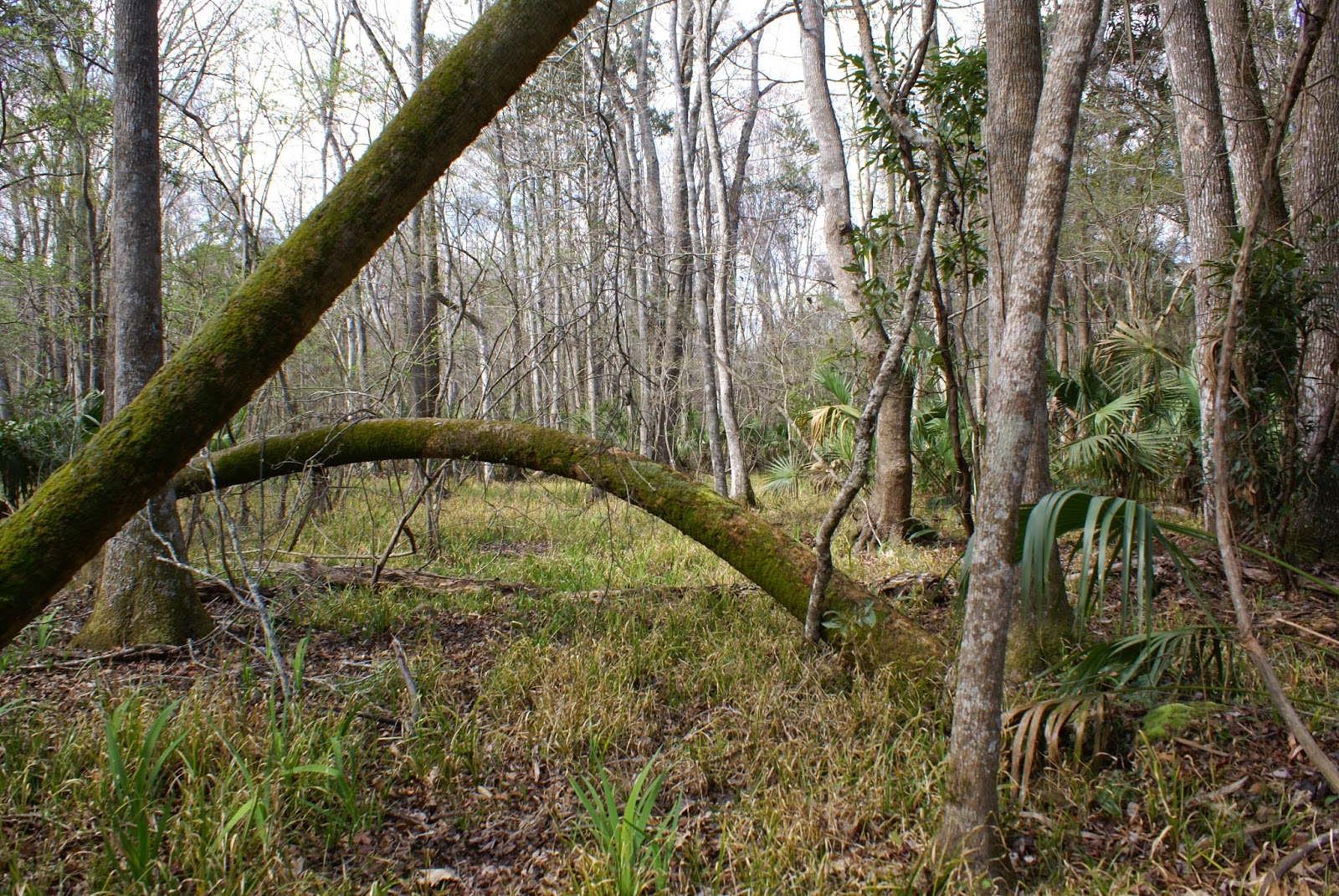
            Charlie said the Pinhook is mostly limestone under the reeds and grass. Trees rooted directly into slabs of moss-covered limestone hang over the water, closing out the sun.
The river narrowed and banks came closer until our boat stopped, the keel caught on a tree fallen across the water. Grabbing a nearby limb in one hand, Charlie yanked on the side of the boat and gunned the motor, sliding us across. 
            We finally turned to head back through the tunnel of trees. When we came out in the open the sky was dark. As soon as we ran clear of the narrow part of the river we sped up, ignoring the danger of hidden rocks. We were unsure whether to head back to the Aucilla or make for Saint Marks by open water where we would be safe.
            The sky turned purple and black, and a strong wind picked up. After a few miles of wind blowing in our faces the clouds moved on to our west. The sun came back out.
            As we turned north back into the Aucilla, we saw a gathering of Wood Storks resting on the limbs of a dead tree. One turned his back and spread his wings to show his eight-foot wing span.

            Overhanging tree limbs cast intricate patterns on the water. We turned left at Ward Island where Charlie stopped at a floating dock. Pointing to a path up the hill he said, “Climb up there and you’ll see a real family fishing cabin. Those folks hauled every stick of lumber in here on a boat.”
            The weathered structure looked shabby but sturdy. A covered porch protected a line of chairs backed up to the wall. I could picture a family enjoying the solitude--adults resting on the porch and children yelling as they played in the woods nearby. 
            Leaving the river, we followed the same route back to Monticello. Soon Charlie turned onto a narrow lane to show us the headwaters of the Wacissa River.
The Wacissa is pristine—as clear as the springs that feed it. Narrow and twisted, it is land-bound and finally disappears into the earth. Its waters connect with the Aucilla through a “Slave Canal,” cut by hand in antebellum times.

            A large part of Jefferson County is like these rivers, still unchanged in hundreds, perhaps thousands of years. Much of the route we covered on this trip is a land and waterscape untouched and undamaged, rare and beautiful.


Saturday, June 6, 2015

Anne Canoeing the Middle Aucilla River

This trip was recorded in video for a segment of the Dimensions program on WFSU. Rob and his helper -- I think his name was Jason -- did a great job of putting hours of filming and interviews of three people together to show the magnificence of this wild river. Robert Daniels was with us, and Doug Alderson with a friend of David's whose name I cannot remember.


David Ward put our canoe in at Lamont at 9:00 AM. He paddled and I took pictures. It took us until 5:00 PM to reach a ruin of a railroad bridge in south Jefferson County. The only locating markers are the standing pilings that once held up the trestle. We exited the river where there was once a town called "Cash Money."

As we moved with the current down river we worked our way around many downed trees. Most of them reached almost completely across the wide river, leaving only a narrow place to canoe or kayak around. We finally found one place impossible to pass so we portaged around taking the opportunity to straighten up and stretch our backs.

David and Robert had checked the passage only a few days earlier, but the river was lower and we finally came to a dead fall we could not go around or under or even pull our craft to the bank and portage around. I sat on the fallen tree, praying my camera was safe as the men pushed the canoe over the log behind me. It was tricky, but I made it back into the canoe without a mishap. All safely over,  we continued down the river.

It's plain to observe the interesting phenomenon of the different soils from one side of the Aucilla to the other. On the Taylor county side we could clearly see the Florida sandy soil and on the Jefferson County side the heavier clay soil that gives its name to the "Red Hills of Florida." Part of our interviews included a discussion of the effect the difference in the soils made for the Apalachees of the Red Hills and the tribes who lived on the sandy soils of eastern Florida. The Spanish traveling across this area commented in their dairies on the larger size and strength of the Apalachee, a likely result of better and more abundant food grown in better soil.

Friday, May 1, 2015

The Treasures of Jefferson County Florida

SECRET TREASURES IN JEFFERSON COUNTY FLORIDA

Monticello is our county seat. Eight miles away, give or take a few steps, you find Lloyd, Wacissa, Waukeenah, Lamont, Aucilla and a couple of villages that are only a place name today, such as Ashville and Fanlew. The eight mile distance is easily explained. A horse or mule and wagon with a farmer and his family sitting atop produce or perhaps simply riding along could easily make a sixteen-mile round trip to the county seat on Saturday or Court day. Early Indian scares required an active militia, men who easily made the eight-mile trip by horseback on Thursday afternoons to drill under the Meeting Oak. 


Jefferson County is about the 12th or 13th Florida county, created in 1827, but settled earlier. A Mr. Robeson or Robertson kept a trading post here from the early 1820s.  The town that grew up around it was called Robeson's Corners. The town’s name was changed to Monticello in 1827 and as with the county name, honoring Thomas Jefferson.


Our treasures are simple, and easily overlooked until you stop and study a while. High ground, hammock to wetland, our land rolls sweetly and is covered in as many shades of green as the fields of western Ireland. This was the favored land of the Apalachees, rich farmland where they grew their sustaining crops.

The Apalachee's farming practices included burning to keep the fields clear. From the time the United States acquired the territory in 1819 these rich open fields were called "Old Fields" and avidly sought by settlers for their plantations. Men came to the area ahead of their families to select and stake out patents that included "old fields" that would allow them to plant a crop immediately. The first-comers didn’t have to spend a year or more clearing away thick stands of pine and oak before plowing. 


Jefferson County forests are still thick and dark green, full of shadows, formidably dense. The extensive flatwoods of the south part of the county are secret to all but hunters and timber men seeking stands of towering cypress—formidable and forbidding forests. Tales abound of bears, panthers and other wildlife lurking in the scrub.

There is an ancient legend of a volcano told and re-told by Native Americans and area settlers. Parties searching for the volcano tell of finding a strangely shaped hill deep in the flat woods. Huge stones are scattered about the hill. Some speculate that this hill may be the site of a peat burn or an underground gas fire. Then again, searchers may not have found the site of the volcano.


The rivers are pristine. Fed by five springs, the Wacissa’s water is icy cold and delightfully clear. A short distance south of the headwaters the Wacissa is augmented by the generous flow of Blue Spring. The Wacissa is confined to the lower central part of the county and joined to the Aucilla by a canal dug by slaves. The “Slave Canal” was designed to move cotton to the Apalachee Bay for shipment to market. 


The Aucilla River forms Jefferson County’s eastern boundary with Taylor County. This river starts in southern Georgia, just below Thomasville and meanders the full length of the county to flow into the Apalachee Bay and the Gulf of Mexico. Not far from Lamont in the southern part of the county, it disappears underground to reappear in small, medium and large windows in the limestone locals call “Sinks.”

The “Aucilla Sinks Trail” follows the underground river, wandering from the Taylor to the Jefferson County side. Sinks range in size from simple cracks in limestone to beautiful small lakes decorated with floating islands of lilies.

The river reappears below Nuttall Rise, running deep and wide around Ward Island, curving into Apalachee Bay and the Gulf. Along the high banks stands of cypress, mixed oak and scrub enclose and reach out into the water. As the water moves into the bay long stretches of saw grass and clumps of palms create a disconcertingly tropical appearance.


You pass the spot on the Taylor County side of the river where the Confederate Salt Works attracted repeated raids by the Federals. Crossing the top of Apalachee Bay the middle cut curves northwesterly and turns into the hidden Pinhook River that sweeps serenely down from the eastern flatwoods part of the Saint Marks Wildlife Refuge. 


On top of our rich and treasured land and rivers--or our deep and broad history as one of the oldest towns in Florida, Jefferson County is the seat of north Florida's high southern culture. This can be experienced during a luncheon or dinner in the restored 1833 Wirick-Simmons House or the Camellia luncheon in the Budd-Carswell house. It is most obvious in the graciousness of the people, many who are descendants of the county's founding families. 


Monday, March 23, 2015

A Different sort of Beautiful

David Ward gave me a priceless canoe trip on the upper Aucilla River last week. The cypress trees are not out yet - the river was out of its banks - We saw ducks and other water birds -- what a wonderful friend.

We put the canoe in the water at Sneads and one other boat unloaded right after we did, but it turned up the river and was out of sight and sound in minutes. We had three plus hours of precious silence. I took several hundred pictures and sometimes pulled on bushes to help the canoe along as David paddled..

The light made mesmerizing reflections in the water. They seemed to change the shape of the water and almost made me want to explore the shadowy underwater forest.

Here are pictures -- words cannot describe the serene beauty. I wondered the whole trip--why weren't there dozens of canoes on the water?


Tuesday, August 19, 2014


BIRDS IN JEFFERSON COUNTY
by Anne H Holt
Monticello, FL


Wood Storks on the Aucilla
On boat trip down the Aucilla to Apalachee Bay and up the Pinhook River I saw a gathering of Wood Storks. There were at least nine birds, resting on the limbs of a dead tree. One particular stork turned his back to us and spread his wings. He appeared to pose as I snapped shot after shot. It’s hard to imagine from a picture how big Wood Storks really are—they sometimes show a wing span of eight feet.

A Swift in the old jail
Sleek, black and timid, I first thought this creature was a large bat, but closer it definitely is a bird. It appears to be attempting to hide in the shadows in the basement staircase of the old jail on Dogwood Street. One or two windows in the building are broken so she found a fine home.

A Watch Hawk on High Street
Songbirds usually greet the day with joyous song in our huge oaks. One screams cheap, cheap, cheap until you want to spend the day shopping. One morning I woke to an almost eerie silence. No bird sang. This hawk is the reason. He perched high in a tree among the Spanish moss and seemed to regard me as an unwelcome intruder. Even the squirrels stop chattering and stay hidden until he moves on. He nests in the park across the street.

An Owl in the Monticello Ecological Park
This bird apparently does not like humans in his park. He lies in wait for a certain runner who regularly visits the park in the early morning --bursts from under the boardwalk—beating the air with his wings to make a startling noise—certainly hoping to frighten the human intruder away

Turkeys in the Monticello Ecological Park.
A flock of wild turkeys, I don’t know how many, hide in the old growth forest—enjoying the freedom and safety of acres of dense, untamed wilderness with plenty of water. These birds occasionally forget to be circumspect and gobble their joy at the abundance of food nature places before them.
Mississippi Swallowtail Kite in the Monticello Ecological Park

This bird was just visiting—skimming along -- twitching his tail. Darting away into the tall trees.

Here is a list other watchers have seen in August in the Monticello Ecological Park.

1 Red-shouldered Hawk 1 17 Aug 2014 David Simpson
2 Red-bellied Woodpecker 1 1     7 Aug 2014 David Simpson
3 Carolina Chickadee 2 1 7 Aug 2014 David Simpson
4 Tufted Titmouse 4 1 7 Aug 2014 David Simpson
5 Carolina Wren 6 1 7 Aug 2014 David Simpson
6 Northern Parula 1 1 7 Aug 2014 David Simpson
7 Northern Cardinal 6 1 7 Aug 2014 David Simpson
8 Downy Woodpecker 1 1 6 Aug 2014 Trail Staff
9 Pileated Woodpecker 2 16 Aug 2014 Trail Staff
10 White-eyed Vireo 1 1 6 Aug 2014 Trail Staff
11 Blue Jay 1 1 6 Aug 2014 Trail Staff
12 American Crow X 1 6 Aug 2014 Trail Staff
13 Great Crested Flycatcher 1 3 Aug 2014 Carol Miller
14 Yellow-throated Vireo 1 3 Aug 2014 Carol Miller
15 Fish Crow 1 1 3 Aug 2014 Carol Miller
16 White-breasted Nuthatch 1 13 Aug 2014 Carol Miller
17 Yellow-billed Cuckoo 1 7 Aug 2014 Carol Miller
18 Red-headed Woodpecker 1 7 Aug 2014 Carol Miller
19 Black-and-white Warbler 1 7 Aug 2014 Carol Miller
20 Cattle Egret 1 3 Aug 2014 Andy Wraithmell
21 Turkey Vulture 1 3 Aug 2014 Andy Wraithmell
22 Mississippi Kite 1 3 Aug 2014 Andy Wraithmell
23 Mourning Dove 2 3 Aug 2014 Andy Wraithmell
24 Chimney Swift 1 3 Aug 2014 Andy Wraithmell
25 Blue-gray Gnatcatcher 1 3 Aug 2014 Andy Wraithmell
26 Northern Mockingbird 2 3 Aug 2014 Andy Wraithmell
27 Hooded Warbler 1 3 Aug 2014 Andy Wrai

Tuesday, May 20, 2014

Finding the Red Hills:
The Most Beautiful Scenic Drive in Florida


The scenic, landscaped corridor linking historic districts in Monticello and Tallahassee is best known as Fred Mahan Drive. Easily the most beautiful twenty-five miles in Florida—it started as a tribal path—became the Old Spanish Trail and is now Route 90, once the main east-west route across Florida.
In 1935, at the height of the depression in our area, Mahan’s nursery of Monticello, then one of the largest plant and tree nurseries in the Southeast, donated thousands of shrubs and trees to beautify the right-of-way along this drive. With federal funds, Jefferson County Highway Department employed thirty-five men at 30 cents an hour to plant the donated shrubs, providing desperately needed jobs at what was a fair rate of pay for the height of the great depression.
The highway right-of-way background, middle and foreground plantings consisted of pyracantha, arbor vitae, flowering crape myrtle, ligustrum and some palm trees. Recent additions of smaller crape myrtles, planted every 100 feet, from the intersection of I-10 and US 90 east of Tallahassee, for twenty plus miles to the edge of Monticello present a spectacular range of brilliant colors throughout the early summer months.
For most of the year the shrubs are lush and green. In winter, bare of leaves and flowers, their cinnamon branches are still attractive. In late April crape myrtles are covered in deep green leaves. In mid-May many of the shrubs begin to produce large clumps of conical white flowers followed by old-fashioned “watermelon pinks” and a few days later the gorgeous dark reds. When the crape myrtles are blossoming this two-lane road running east from Tallahassee to the historic City of Monticello, Florida is a never to be forgotten treat, easily the most beautiful drive in Florida.
This beauty is worth seeing and preserving. Some Florida citizens demonstrated their appreciation in the 1990’s when early one Monday morning a Florida Department of Transportation crew discovered vandals had attacked and all but destroyed an expensive, high-tech wood chipping device. Apparently tired of mowing around bushes, the crew started to use this machine to “clear” the shrubbery from both sides of Highway 90 east late that Friday afternoon. After cutting down and chewing up a few crape myrtles and other shrubs they cut the machine off and left for the weekend.
Luckily, a reporter saw the big machine devouring the crape myrtles on Friday and submitted a story to the local paper. The outcry was almost unbelievable. Telephone lines seemed to catch fire from Monticello to Tallahassee to Washington, DC. Angry people called to demand help from Jefferson and Leon County elected representatives to stop the destruction.
Sometime Saturday or Sunday evening, someone—a nature lover I assume, cut the hydraulic lines, rendering the valuable machine useless. This action and subsequent news stories and the frantic, angry telephone calls stopped the desecration and saved the beauty for us to enjoy today.
If you slow down a little so you can enjoy the wonderful view, you can see an occasional sturdy-looking palm tree tucked in behind the crape myrtles. The Ligustrum blossoms just before the Crape Myrtles, the large rounded shrubs appear dusted with snow and smell as sweet as honeysuckle. You will even see a few overgrown and badly misshapen arbor vitae, but not a single pyracantha.

Monday, March 10, 2014

Monticello's Beautiful and Mysterious Setting

The Jefferson County Florida Flatwoods

The Flat Woods of Jefferson County Florida are a world out of time. This remote and mysterious area is almost impenetrable and unknown except by a few hunters, fishermen, and scientists. The Flat Woods are located in South-central Florida, at the edge of the Apalachee Bay and the Gulf of Mexico.

These remote tangled woods and swamps are bordered on the east by the Suwanee River and on the west by the Wakulla. The area is split by the mysterious, disappearing Aucilla River and graced by the spring-fed Wacissa and the lost Pinhook.

These woods and swamps boast as diverse a collection of botanical specimens as any place in the world not a rain forest. Sinkholes pierce the porous limestone underlying the jungle-like growth of oak, pine and palm, adding to the ancient mystery.

The treasures of this vast crescent, reaching almost 100,000 acres, lie deep. They are hidden from all but scientists, trained divers and special equipment. The knowledge hidden here is covered by a blanket of rotted plant life to a remarkable depth; a covering that provides anaerobic security for the remains of humans and animals waiting through centuries to tell the story of the settlement of North America.

This area has been of great interest to anthropologists, archaeologists and other scientists for many years. The evidence they have gathered through several “digs” suggests eons of settlement by humans, possibly some of the earliest settlement in North America.

The pressing question developing as all of this evidence accumulates is whether or not the first settlement in North America came from the east or from the northwest. Could the first North American settlers have come across the ice from Europe? The answer lies waiting in the Flat Woods under a deep blanket of plant waste, protected by a lack of oxygen and waiting to be uncovered.


Saturday, December 21, 2013

Christmas Dinner on the Monticello Food Trail
Anne Haw Holt

I’m so thankful I was born in the South. If I hadn’t been I would hire someone to teach me to speak with a Tidewater accent then I would lie. Yes, I would just plain-out lie. I’d swear I was born in Richmond Virginia or Monticello Florida. I’d have dozens of cousins and at least one eccentric uncle. My father would be handsome and my mother would be a true lady, educated somewhere like Mary Baldwin or Radford College. Southerners just know how to live.

Christmas dinner at the restored 1833 Wirick-Simmons House in Monticello was like taking a trip back in time—a house full of people, happy and interested, where even newcomers are treated as old friends. The lighting was a soft glow on the pale walls and high ceilings, showing off the museum quality furniture. It made the women more beautiful and the men more interesting.

The men and women of the Jefferson County Historical Association dressed the tables in white linen with crisp cloth napkins folded at each place. Polished silver utensils, a tall crystal wineglass and a stemmed silver water cup graced every plate. The candles flickered in soft breezes from the open doorways. Someone with artistic handwriting created name cards.

We talked—oh, how we talked—between each course of the delicious meal. We ate beef tenderloin done to a turn, served with potatoes, vegetables and tiny, delicious Parker House rolls. Our dessert was a piece of chocolate pie with a cherry sauce and steaming coffee. It was obvious no one wanted the evening to end.

The Wirick-Simmons House Christmas Dinner showcased our southern tradition of good food, perfectly prepared and elegantly presented to a house full of friends. Nothing could be better—it is the South at its best.


Sunday, December 1, 2013


Florida Frontier: The Aucilla, Pinhook and Wacissa Rivers
We drove south out of Monticello at dawn. At Mandalay we slid an open boat into the Aucilla. Our guide Charlie Ward sat in the back at the tiller with Jack Carswell beside him. I sat amidships to take pictures.
A smoky look hung over the Aucilla. After only a few hundred yards the sun came out to throw sparkles over the rippling water. Charlie picked out his route along the curved riverbanks.
“There are sharp rocks hidden under the surface of this water. One of those things can rip the boat to pieces.”
We entered a maze of channels between curving stretches of marsh grasses dotted with palms, twisted cedars and willows. At Apalachee Bay Charlie pointed out Saint Marks Lighthouse and the almost hidden mouth of the Pinhook.
Charlie said the whole Pinhook area is mostly limestone under the reeds and grass. Trees rooted directly into slabs of moss-covered limestone hung over the water, closing out the sun. The river narrowed and banks came closer until our boat stopped, the keel caught on a tree stretched across the water.
Grabbing a nearby limb in one hand, Charlie yanked on the side of the boat and gunned the motor, sliding us across the log. The water became shallower and the river narrower.
We turned to head back through the tunnel of trees. When we came out in the open again the sky was dark. As soon as we ran clear of the narrow part of the river we sped up, ignoring the danger of hidden rocks. We were unsure whether to head back to the Aucilla or make for Saint Marks by open water where we would be safe.
The sky turned purple and black, and a strong wind picked up. Jack and I argued we wouldn’t melt in rain and a case protected my camera. After a few miles of wind blowing in our faces the clouds moved over us and on to our west. The sun came back out.
As we turned north back into the Aucilla, we saw a gathering of Wood Storks resting on the limbs of a dead tree. One stork turned his back and spread his wings, appearing to pose for me.
As we headed up the river reflections of overhanging tree limbs cast patterns on the water. We turned left at Ward Island where Charlie stopped at a floating dock. Pointing to a path up a hill, he said, “Climb up there and you’ll see a real family fishing cabin. Those folks hauled every stick of lumber in here on a boat.”
Gray and weathered, the large structure looked shabby but sturdy. A covered porch ran across one side with a line of chairs backed up to the wall. I could picture a family enjoying the solitude--adults resting on the porch and children yelling and playing in the woods nearby.
Leaving the river, we followed the same route back to Monticello until Charlie turned onto a narrow lane to show us the headwaters of the Wacissa River.
The river is pristine—as clear as the springs that feed it. Narrow and twisted, it is land-bound and finally disappears into the earth. Its waters connect with the Aucilla through a “Slave Canal,” cut by hand in antebellum times.
A large part of Jefferson County is like these rivers, still unchanged in hundreds, perhaps thousands of years. Much of the route we covered on this trip is a land and waterscape untouched and undamaged, rare and beautiful.


Saturday, November 16, 2013


Monticello to Tallahassee on Route 90:
The Most Beautiful Drive in Florida

The scenic, landscaped corridor linking historic districts in Monticello and Tallahassee is Washington Street in Monticello to Tennessee and Mahan Streets in downtown Tallahassee. That part of Route 90 is best known as Fred Mahan Drive. Easily the most beautiful twenty-three miles in Florida—it started as a tribal path—became the Old Spanish Trail and is now Route 90, once the main east-west route across Florida.

In 1935, at the height of the great depression in our area, Mahan’s nursery of Monticello, then one of the largest plant and tree nurseries in the Southeast, donated thousands of shrubs and trees to beautify the right-of-way along this drive. Jefferson County Highway Department employed thirty-five men at 30 cents an hour to plant them, providing desperately needed jobs at what was a fair rate of pay for the depression years.

The highway right-of-way background, middle and foreground plantings consisted of pyracantha, arbor vitae, flowering crape myrtle, ligustrum and some palm trees. Recent additions of crape myrtles, planted every 100 feet, from the intersection of I-10 and US 90 east of Tallahassee, for twenty odd miles to the edge of Monticello present a spectacular range of brilliant colors throughout the summer months.

For most of the year the shrubs are lush and green. In winter, bare of leaves and flowers, their cinnamon branches are still attractive. In late April crape myrtles are covered in deep green leaves. In mid-May many of the shrubs begin to produce large clumps of conical white flowers followed by old-fashioned “watermelon pinks” and a few days later the gorgeous dark reds. When the crape myrtles are blossoming this two-lane road running east from Tallahassee to the historic City of Monticello, Florida is a never to be forgotten treat, easily the most beautiful drive in Florida.

This beauty is worth seeing and preserving. Some Florida citizens demonstrated their appreciation in the 1990’s when early one Monday morning a Florida Department of Transportation crew discovered vandals had attacked and all but destroyed an expensive, high-tech wood chipping device. Apparently tired of mowing around bushes, the crew started to use this machine to “clear” the shrubbery from both sides of Highway 90 east late that Friday afternoon. After cutting down and chewing up a few crape myrtles and other shrubs they cut the machine off and left for the weekend.

Luckily, a reporter saw the big machine devouring the crape myrtles on Friday and submitted a story to the local paper. The outcry was almost unbelievable. Telephone lines seemed to catch fire from Monticello to Tallahassee to Washington, DC. Angry people called to demand help from Jefferson and Leon County elected representatives to stop the destruction.

Sometime Saturday or Sunday evening, someone—a nature lover I assume, cut the hydraulic lines, rendering the valuable machine useless. This action and subsequent news stories and the frantic, angry telephone calls stopped the desecration and saved the beauty for us to enjoy.

If you slow down a little so you can enjoy the wonderful view, you can see an occasional sturdy-looking palm tree tucked in behind the crape myrtles. The ligustrum blossoms just before the crape myrtles, the large rounded shrubs appear dusted with snow and smell as sweet as honeysuckle. You will even see a few overgrown and badly misshapen arbor vitae, but not a single pyracantha.

Sunday, November 10, 2013

Monticello is the county seat of Jefferson County Florida. Some of the treasures of our county are clean rivers and unsullied wilderness. Here is my description of our "Flatwoods"

The Flat Woods of Jefferson County Florida are a world out of time. This remote and mysterious area is almost impenetrable and unknown except by a few hunters, fishermen, and scientists. The Flat Woods are located in South-central Florida, at the edge of the Apalachee Bay and the Gulf of Mexico.

These remote tangled woods and swamps are bordered on the east by the Suwanee River and on the west by the Wakulla. The area is split by the mysterious, disappearing Aucilla River and graced by the spring-fed Wacissa and the lost Pinhook.

These woods and swamps boast as diverse a collection of botanical specimens as any place in the world not a rain forest. Sinkholes pierce the porous limestone underlying the jungle-like growth of oak, pine and palm, adding to the ancient mystery.

The treasures of this vast crescent, reaching almost 100,000 acres, lie deep. They are hidden from all but scientists, trained divers and special equipment. The knowledge hidden here is covered by a blanket of rotted plant life to a remarkable depth; a covering that provides anaerobic security for the remains of humans and animals waiting through centuries to tell the story of the settlement of North America.

This area has been of great interest to anthropologists, archaeologists and other scientists for many years. The evidence they have gathered through several “digs” suggests eons of settlement by humans, probably some of the earliest settlement in North America.

The pressing question developing as all of this evidence accumulates is whether or not the first settlement in North America came from the east or from the northwest. Could the first North American settlers have come across the ice from Europe? The answer lies waiting in the Flat Woods under a deep blanket of plant waste, protected by a lack of oxygen and waiting to be uncovered.


Sunday, July 28, 2013


Jefferson County’s Artisans and Growers Market is close to completing its second full year of operation. We will soon be qualified to accept SNAP cards.
The Artisans and Growers Market is sponsored by Main Street Monticello. Our primary goal is to provide a place where creative people and small growers in our area can afford to sell their products. Our strict rule is – you must MAKE IT, BAKE IT, SEW IT, or GROW IT to sell an item in this market.”
Establishing a market such as this takes a long time. We expect that to happen and are determined to stick to our goal until we succeed. We hope to build a customer base that truly appreciates things handmade and home grown. We sell a great variety of items, from t-shirts, free-range eggs to vegetables and beautiful flowering plants. Sellers offer such interesting and varied things as Mayhaw jelly, brownies and peacock feathers.
Main Street has struggled to find the perfect place to hold the market. The first few months we met in the yard of the old Jefferson County Jail on west Dogwood Street. That was tough, with no shade, no bathroom and few customers. Hal Bennett was kind enough to allow us to use his porch at Johnston’s Market last year. That was much better, we were at least on the main highway and found more customers.
This spring, the Jefferson County Historical Association offered Main Street the use of their beautiful garden behind the Wirick-Simmons house. Located at the corner of Cherry and Pearl Streets, we now erect our green tents behind their beautiful white picket fence around the garden before 9:00 AM every first Saturday.
Our next market will be Saturday August 3, 2013. We hope the weather will cooperate. If it does, we will have interesting sellers offering their products for sale. What we need now are buyers. We need you and a crowd of other interested Monticello and Jefferson County buyers to support and encourage us.

Anne

Thursday, April 4, 2013

Observing Small town Politics

          I attend almost every Monticello City Council meetings--and stay from gavel to gavel. It's something I pledged to do as a leader of Main Street Monticello. I believe it will establish in the mind of the councilors my dedication to the goals of Main Street Monticello and show my respect for their work for the 2506 citizens of our beautiful little city.
          Many people come before Council, ask for what they need and then promptly leave the room. Even the newspaper reporter doesn't always stay for the entire proceedings. This seems a little slighting to the councilors to me. They work hard and give a lot of time and effort to do our business and my full attention is a small thing I feel obligated to give. It seems to me they appreciate my occasional comment on a matter they are discussing.
          The Monticello City Council is impressive to anyone who sits through a complete meeting in that it moves through its agenda smoothly, pushing to complete the people's business quickly and carefully. There is little debate and what there is is respectful. I see no animosity and no bickering. Surely they disagree, but no debate ever seems personal. The contrast between the Monticello City Council and the Jefferson County Commission is truly staggering.
          I don't always attend Jefferson County Commission meetings, but when I do I still follow my policy of showing my respect for the commissioners and their office by staying throughout the meeting and occasionally commenting on matters under discussion. Most of the people who come to the meetings to make a point or ask for something wait until their matter is on the floor, comment if necessary, then get up and leave. A few people stay throughout the meeting, but most of the people who stay are county employees.
        The proceedings of our Commission are shockingly slow, scattered and inefficient. Several Commissioners blatantly display disrespect and disdain for each other, falling into tone of voice and expression displaying nothing short of hatred.
          I tell myself that surely friends of these Commissioners will talk to them and remind them of their responsibility to put the people's business first, respecting each other's differences without displaying their animosity publicly. It's embarrassing. the Commissioners also spend most of their time discussing this and that with the County Coordinator who seems to have become the "Jefferson County Road Commissioner."
         The only thing I see to do is recruit candidates to replace these two Commissioners--candidates who can disagree without becoming so blatantly angry and disrespectful of
the people of Jefferson County, rally behind them to elect replacement commissioners who can put their responsibilities above their personal feelings.

Anne

Tuesday, March 26, 2013

MAIN STREET MONTICELLO ANNUAL REPORT 2012


Main Street Monticello’s mission is to revitalize business in Monticello and Jefferson County while protecting our historic buildings and culture. We include the small towns of Lloyd, Waukeenah, Wacissa, Lamont and  Aucilla in our work. We experienced some success in 2012, bringing in grant money to fund events that attracted people to our town and delivering traffic to our businesses. We plan to do more in 2013, and expect it to be a banner year.

Our members volunteered with us and also helped with events other non-profit groups presented throughout the year. We continued Main Street’s Halloween Fun, Around the Downtown Christmas, Street Flags and Main Street Mixers. With the help of the Jefferson County Historical Association, the Tourist Development Council
and members of almost every non-profit group in town, we attracted over 600 people to our very successful First Floridians First Americans Conference in our beautiful opera house. We plan to repeat the conference in 2015.

The First Floridians Conference resulted in a new archaeological dig in Jefferson County. This site promises to yield important scientific evidence. The Conference also inspired a group of local leaders to form a new non-profit to establish a First Floridians Scientific and Cultural Center in Monticello. The Main Street Board of Directors and some of those same Community leaders are working on the Jackson Square Project. Our goal in Jackson Square is to restore each beautiful old building in the Square to house residences and a thriving downtown business.
Work is progressing steadily on our Old Jail Museum project on Dogwood Street. Grant money will fix the roof and windows, add HVAC, new outside doors and a de-humidifier. A professional photographer will record the prisoner’s writing on the walls. Wonderful volunteers more than match the grant money with the value of many, many hours of work cleaning and improving the building. Plans call for opening the Museum for limited hours this spring.

The Main Street Artisan and Growers Market will be two years old in April and qualify to accept EBT Cards to pay for food. We’ll plan to apply for the USDA Farmer’s Market Grant. Our core of local artists and growers offering products for sale continues to grow and we are seeking a more central and permanent market location where we can build a sustaining customer base. We will open in the Wirick Simmons House Garden on Saturday April 6.
Watch around town for Main Streets’ “Little Free Libraries.” Several individuals and businesses are sponsoring them. The Jefferson County Public Library and many volunteers’ promise to make sure there are always books available and the free libraries will make them convenient.

We will partner with Jefferson County Historical Society and Jefferson Arts to present an eight-week-showing of Florida Wild Flower Paintings by Moran in September and October 2013. Local painters and photographers of wild flowers will show their work at the same time. Our Garden Club will offer Florida Wild Flower seeds for sale.


Main Street Monticello will present Jefferson County Pioneer Journey Stories starting on January 31 in the Jefferson County Courthouse. We will offer other events this year where descendants of territorial settlers will tell how their families came to our area. A historian will tell us about traveling to Monticello by stagecoach.

The next Pioneer Journey Stories event will be on May 2 at the Episcopal Church Fellowship Hall in partnership with the Jefferson County Historical Association

We will scan family pictures into a computer so they can become part of the Florida Memory Collection in the Florida Archives and part of the Jefferson County Genealogy Library’s Collection. These events will be recorded on DVD.

Main Street Monticello leaders will apply the Journey Stories theme to other events throughout 2013. Local veterans will tell how they left Jefferson County to enter the military and traveled to serve our country in other states and countries. Veterans’ and Pioneers’ Journey Stories are our local contribution to the six-week-long Smithsonian Museum traveling Exhibit titled “Journey Stories” that Main Street Monticello and partner groups will bring to the Jefferson Arts Gallery in January and February of 2014.
We’re working hard and planning great events for the future. Definitely a 2015 First Floridians First Americans Conference


Tuesday, March 19, 2013

Cemetery and Home Tour getting ready to go


Members of Jefferson County Historical Association are working hard to get ready for the Roseland Cemetery and Home Tour this Saturday, March 23, 2013. WFSU will be there to record the vignettes in the Cemetery to show on TV. We will have a private videographer as well so we can make our own recording to be made into a DVD.

There has been a lot of publicity for this event. Articles in newspapers, flyers everywhere and news all over the internet. I hope we have a good crowd. Places like COCA in Tallahassee, WFSU, The Morning Show, The Visitors Bureau in Thomasville, GA and Monticello News and others have been wonderful in getting the word out.

In the mean time we are working along on ideas coming out of the First Floridians First Americans Conference. Yesterday we had a discussion about who to invite to the second First Floridians First Americans Conference planned for October 2015. I plan to call the Smithsonian and invite Dennis Stanford. I also want Lee Newsom. She may be almost to famous for us by then, but I will try.

Monday, March 11, 2013

My Monticello This Week


Things are hopping in Monticello and Jefferson County. Jefferson Street, our main street looks wonderful with three businesses in the old Edenfield Hardware building. The Tractor Supply building is going up fast on South Jefferson and the Pecan Company building at the entrance of the industrial park is taking shape. Several small businesses are almost ready to open with the help of Dallas Garrett in the County's Small Business Development Office.

I'm trying to find someone in Monticello, Lloyd, Waukeenah, Wacissa, Lamont and Aucilla to make up a poster with a short history of the town and a bunch of pictures, both old and new. The Smithsonian Exhibit we will show in the Art Gallery next winter is all kiosks, leaving the walls bare--posters of Jefferson County Towns should be on the walls for visitors to see. Main Street purchased two scanners to we can copy and digitize old pictures without taking them out of albums, picture frames or damaging them in any way. My email is ahholt@ahholt.com please email me if you will take on this job for your town. I am also listed in the Monticello phone book.

The next big thing everyone will love is the 1827 Roseland Cemetery and Home Tour put on by the Jefferson County History Association. Main Street Monticello is pitching in to video tape the Cemetery reenactments. There will be ten different vignettes ranging from Senator Pasco and his wife Jesse to Boots Thomas and Major Bird. Everything starts at the Wirick-Simmons House at 10 AM Saturday March 23. Don't miss it.

One of the producers of the Dimensions Program on WFSU TV will be filming the whole Cemetery and Home Tour. That program will tell the whole world how beautiful and precious Monticello is.

 The old Jefferson County Jail at 380 W. Dogwood Street (same building as the election office) will be open from 10AM to 5PM for tours as well as eight houses around town. We are working hard to make it into a museum someday, but we want people to see how much we have been able to do so far with a great deal of help from volunteer hours by concerned citizens, a small grant from Capital City Bank and a grant from the state of Florida

Anne Haw Holt.

Friday, March 8, 2013

Making news this week in Monticello Florida

This week has been a busy time. Everything is clicking around Monticello. I attended the Jefferson County Historical Association's Board Meeting Monday morning as their liaison with Main Street Monticello. They approved the Artisans and Growers Market using the new Wirick-Simmons Garden for our activities.

We will continue holding the market only on the first Saturday for a while, but later several sellers want to be open the first and third Saturdays and someday possibly every Saturday. We expect the move will increase or traffic dramatically and that will attract more sellers. April will complete our second year.

If that is not enough for this week, I attended the Main Street Board meeting Monday evening and they voted to purchase 6 pop-up tents for the Market. That will give us an attractive, uniform appearance and make us appear more professional.

Mr. Strickland's Farmer's Market was again mentioned. He seems to think we are trying to take his business, but we can never be any competition for him - we are a different sort of market anyway.. He should always have a table at our Market with his "Monticello" products and flyers telling people his wonderful market is open every day.

My friend Mike Plummer of WFSU TV came out Tuesday AM and after talking about an hour decided to video the Home and Cemetery Tour. I took a lot of pictures of Senator Polk and his wife Jessie in costume down at Roseland Cemetery. He also agreed to video for TV the "Little Free Libraries" when they are complete and in place.

Then I went to the City Council meeting as usual. It is interesting to be there every month and stay from gavel to gavel.


Sunday, February 10, 2013


Monticello is the home of The Foundation for the Preservation of Historic American Music, Inc, the creator and organizer of the “Southern Music Rising” annual music festival and other local music events.
    Jefferson Arts, Inc is made up of local artists who practice many different art forms including sculpture, painting, fiber art, potting, woodcarving and photography. The art center is housed in a historic school building and includes a gallery. The Jefferson Arts Gallery, Rosemary Tree, Tupelo’s and other local venues offer the work of local artists for sale.
    Nationally known and local historians, novelists and other writers present their works in reading and signing events and book launches. Several sell their books through local stores. Poets read original work in our library and other venues.
Monticello Opera House


Monticello artists and artisans offer music, theatre and dance in our historic1890 Perkins Opera House and a Friday night Jamboree with music and dancing. Main Street Monticello hosts Singer/Songwriter events by local and Nashville songwriters. Musicians and music lovers from all over the country attend and enjoy our growing “Southern Music Rising” festival held every spring. As many as six stages are placed around Monticello’s streets for live music. The Opera House, empty lots and even some front porches are pressed into service to present dozens of performers.